
America’s Exploding Debt — Are You Protected?

I’ve watched families build wealth over decades — only to see its real value quietly eroded by forces they don’t control. Today, one of the biggest of those forces is government debt.
U.S. national debt has climbed to roughly $38.6 trillion as of early 2026. That number alone doesn’t tell the full story. What matters is how that debt is financed, how it influences interest rates, and how it ultimately affects purchasing power.
For long-term investors, especially those nearing retirement, this isn’t abstract. It directly shapes the returns you earn — and what those returns are actually worth.
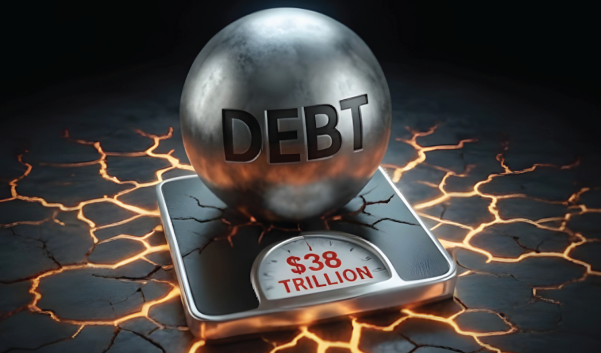
Did you know that America is currently heading toward bankruptcy?
There's a silent financial heist happening right now across the United States.
No ski masks. No bank vaults. Just a history of bad policy, inflation, and economic mismanagement—quietly draining the wealth of everyday Americans…being wasted by direct taxation or inflation.
The U.S. national debt just smashed through $38.66 Trillion as of January 2026. And previously, Washington's answer?
🚫 Print more dollars
🚫 Borrow more from foreign countries
🚫 Postpone the consequences for tomorrow
You don't need to be a financial expert to know that…
- Rising debt means fewer economic opportunities for Americans to buy a house or car…
- Rising debt slows economic and wage growth…
- Rising debt increases inflation…
So, if you have $50,000 or more in an IRA, 401(k) or TSP, your retirement savings may be at risk.
YOU MAY BE AT RISK IF…
☑️ You hold a 401(k), IRA, or TSP.
☑️ You have more than $50,000 put away for retirement.
☑️ You are worried about your life savings becoming worthless.
Just one unexpected event—like a global conflict or a debt default—could erase trillions in household wealth.
But there is a way to help protect your wealth RIGHT NOW.
It's a little-known IRS-approved strategy that allows you to legally and tax-free transfer your retirement funds into a private, stable asset class — completely outside the reach of market volatility.
It's been…
✅ Historically safe for over 50+ years
✅ Hedged against market volatility
✅ Preserved during times of inflation, political turnover and war
You've worked hard to build your retirement savings. Don't let poor policy decisions in D.C. quietly destroy it.
Learn how to help protect your wealth before it's too late. We've outlined a wealth protection strategy inside the 2026 Retirement Protection Guide — and it's completely FREE.
Inside this guide, you'll discover an IRS-approved loophole that allows you to move your retirement savings tax-free and penalty-free into a safe haven asset and hedge your wealth against inflation, market volatility and rising debt.
So don't let Washington destroy your retirement savings…
How Did Debt Rise This Fast — and Why It Matters
The surge in U.S. debt didn’t happen overnight. It reflects years of persistent deficits, pandemic-era stimulus, higher interest costs, and continued fiscal expansion.
Deficits are now running at roughly 5–7% of GDP annually — levels historically associated with recessions or crises, not peacetime expansions.
At the same time, interest costs are becoming one of the fastest-growing components of federal spending. As older, low-rate debt rolls over into higher yields, the burden compounds.
For investors, this creates a difficult environment. Higher debt levels tend to push yields upward over time, which puts pressure on bond prices. At the same time, inflation risk remains structurally elevated.
That combination—rising yields and persistent inflation — is particularly challenging for traditional retirement portfolios.
Is the Fed Protecting Markets — or Creating New Risks?
The Federal Reserve is walking a narrow path.
After aggressively tightening policy in 2022–2023, it has tried to stabilize inflation without triggering a deep recession. Its balance sheet remains large by historical standards, even after some reduction.
The challenge is this: keeping rates too low risks reigniting inflation, while keeping them too high increases debt servicing costs and financial stress across the system.
This tension doesn’t disappear — it gets deferred. And markets eventually have to absorb it.
For retirement portfolios heavily exposed to long-duration bonds, this creates ongoing volatility rather than stability.
What History Suggests About High-Debt Environments
We’ve seen versions of this before.
During the 1970s, rising debt levels combined with supply shocks and loose monetary policy led to sustained inflation. Real returns on bonds were negative for much of the decade.
After the 2008 financial crisis, debt surged again. While inflation remained subdued for years, asset prices became increasingly dependent on low rates and liquidity.
Today’s environment blends elements of both periods: structurally high debt, elevated inflation risk, and tighter financial conditions.
That combination is rare — and it requires a different approach than the classic 60/40 portfolio.
Why Bonds Are No Longer a “Safe Anchor”
For decades, bonds provided stability and income. That assumption is being challenged.
When yields rise, bond prices fall. This is basic duration math. The longer the maturity, the greater the sensitivity.
In 2022, many investors experienced this firsthand as both stocks and bonds declined simultaneously — something that had been rare in prior decades.
In a high-debt environment, this risk doesn’t disappear. It becomes more structural.
That doesn’t mean bonds are useless. It means they need to be managed differently— shorter duration, selective exposure, and realistic expectations.
How Investors Are Adapting
Rather than abandoning traditional portfolios, many investors are adjusting them.
There’s a growing shift toward assets that can better withstand inflation and currency pressure. Commodities, real assets, and selective equities with pricing power are seeing renewed interest.
Gold, in particular, has regained attention during periods of fiscal stress and geopolitical uncertainty. It’s not a perfect hedge, but historically it has performed well during episodes of monetary instability.
At the same time, global diversification is becoming more relevant. Concentration in a single currency or economy carries more risk when fiscal imbalances widen.
The goal isn’t to predict a crisis — it’s to build resilience if conditions deteriorate.
So What’s the First Move?
If you’re managing a six-figure retirement portfolio, the first step isn’t panic. It’s clarity.
Understand your exposure to interest rates. Know how much of your portfolio depends on stable inflation and falling yields. Evaluate whether your current allocation reflects the world as it is — not the one that existed over the past decade.
The biggest risk in this environment isn’t volatility. It’s assuming that old models will continue to work unchanged.
Debt at these levels doesn’t guarantee collapse. But it does change the rules of the game.
And for long-term investors, adapting early is often the difference between preserving wealth — and slowly losing it without realizing why.