Why isn’t gold rising on war news?

War breaks out.
Oil spikes. Markets shake. Headlines turn urgent.
And gold… falls.
At first glance, that doesn’t make sense. Gold is supposed to be the ultimate crisis hedge—the asset investors run to when the world becomes unstable.
So why isn’t it working that way now?
That question is more important than it looks. Because it reveals how markets actually behave under stress—and where the real opportunity may be forming.
You’re reading The Growth Thesis — a publication for people who think beyond headlines.
Founded by Markus Drop, it’s built to cut through noise and focus on what actually drives long-term wealth: economic cycles, capital allocation, and investor behavior.
No hype. No speculation.
Just clear thinking for sustainable growth.
Since the outbreak of war, gold is down roughly 3.5% – and prices of the best gold stocks are down even more. Why isn’t gold going up?
Let me explain:
First of all, gold rose roughly 180% from its bottom in 2022. A move that massive is not normal. Every repricing event is always followed by a rest.
Some of gold’s sideways price action is nothing more than gold taking a breather after a blistering run in 2024-2025.
Secondly, most people think gold is a crisis hedge that benefits when the world erupts in chaos. This is true – but probably not the way you think…
Yes, you want to own plenty of gold when the world is in chaos – like now.
But the gold price normally doesn’t go vertical when the bombs start falling.
Gold is primarily a slow-moving, long-term play on the decreasing value of paper assets and fiat currencies – aka inflation.
War will certainly accelerate the decline of the dollar’s purchasing power, but this doesn’t show up in the gold price immediately after a war begins.
In fact, the initial reaction to the war in Iran was for the dollar to strengthen.
It’s still seen as a safe-haven asset by most of the world.
Gold is way under-owned by the average retail investor – even though central banks now hold more gold than US Treasuries for the first time in 30 years.
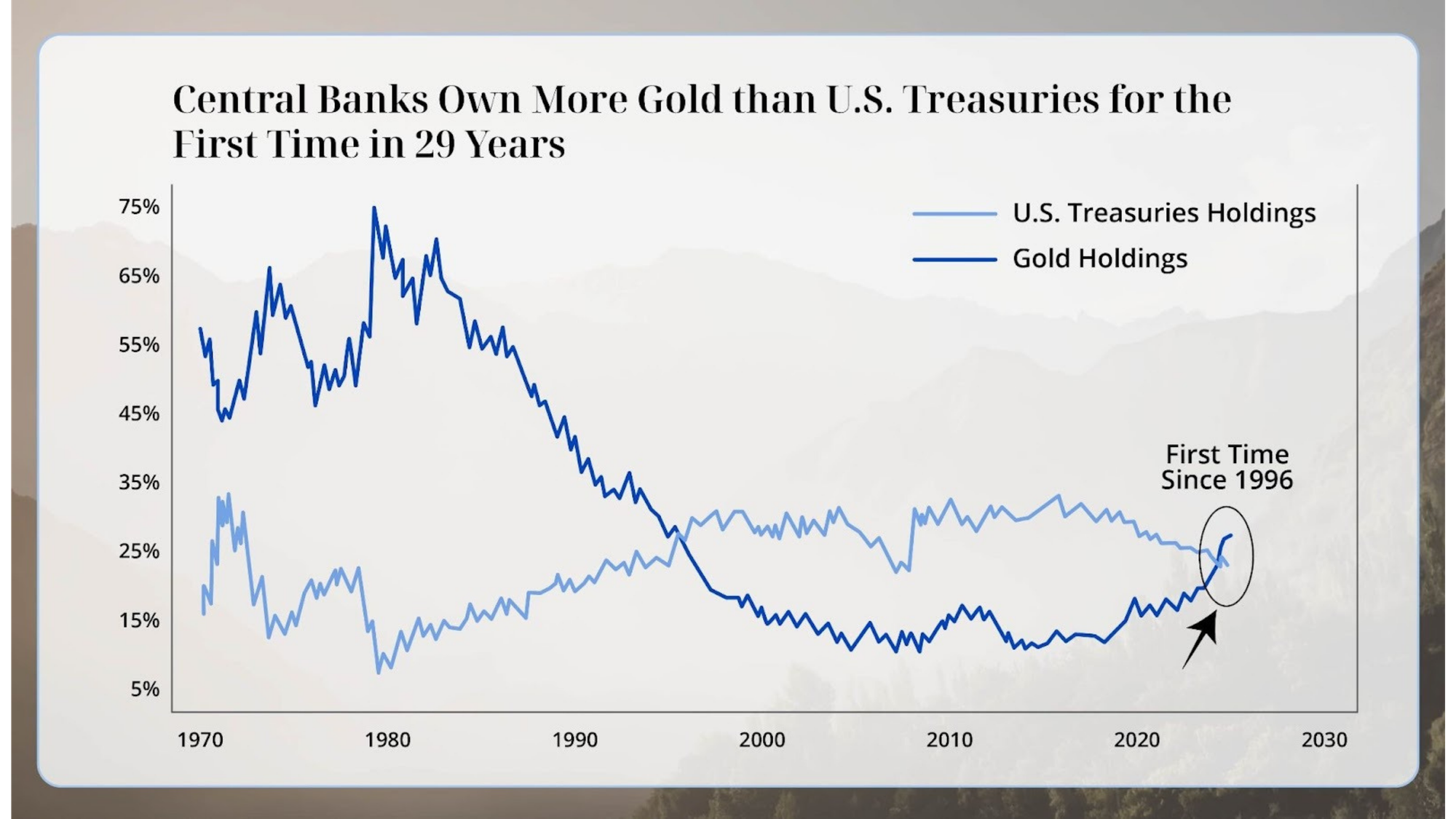
A big move is yet to come when retail investors finally show up. Not only that…
The dollar will eventually devalue much, much lower. It has to. All the problems that existed before the war are still present – and accelerating.
The direction of travel is still the same: The dollar is losing both value and dominance throughout the world – a trend that will continue for years to come.
As the dollar falls in value and purchasing power, it will make the gold price appear to rise.
Gold is the ultimate hedge against inflation and the policies now running the world.
That’s why you need gold. But I do not recommend buying bullion at today’s prices.
Because the best gold miners are now selling at fire-sale prices thanks to recent volatility from the war in Iran.
When the “Obvious Trade” Doesn’t Work
In the early phase of geopolitical shocks, markets don’t always move toward the most logical long-term outcome.
They move toward liquidity.
That’s exactly what we’ve seen in recent weeks. Despite rising geopolitical tension around Iran, the U.S. dollar strengthened, pulling capital toward itself as a global reserve safe haven. Gold, meanwhile, experienced a pullback.
This isn’t unusual.
Historically, during the initial phase of crises—from the Global Financial Crisis to the COVID-19 market crash—investors often sell what they can, not what they should. Liquidity becomes priority number one.
Gold doesn’t escape that dynamic in the short term.
The Macro Forces Haven’t Changed—They’ve Intensified
If you step back from short-term price action, the bigger picture looks very different.
Central banks are still accumulating gold at one of the fastest paces in decades. According to data frequently cited by organizations like the World Gold Council, official sector demand has surged as countries diversify away from dollar-based reserves.
At the same time, structural pressures in the global economy remain firmly in place:
- Government debt levels across developed markets continue to rise
- Real interest rate stability is increasingly uncertain
- Currency debasement remains an embedded feature of the system
Even institutions like the International Monetary Fund have warned that prolonged geopolitical conflict—especially one affecting energy markets—can fuel inflation while slowing growth.
That combination doesn’t weaken the long-term case for gold.
It strengthens it.
Why Gold Often Moves Later—Not First
There’s a misconception that gold reacts instantly to chaos.
In reality, it tends to respond to what chaos creates.
War doesn’t immediately reprice currencies or debt. But it accelerates the forces that eventually do—higher spending, higher deficits, more pressure on monetary systems.
That process takes time to show up in pricing.
Which is why gold often lags in the early phase… and then moves more decisively once the second-order effects become visible.
Where the Market May Be Mispricing Risk
This is where things get interesting for investors.
Because while gold itself has pulled back modestly, parts of the broader gold ecosystem have seen sharper declines. That divergence suggests the market may be pricing short-term uncertainty while underestimating longer-term dynamics.
And this isn’t happening in isolation.
Across markets, we’re seeing similar patterns:
- Energy volatility feeding into inflation expectations
- Equity markets struggling to price policy uncertainty
- Capital rotating unevenly across sectors
Gold is simply another piece of that puzzle.
But one that tends to matter more over longer time horizons.
The Bigger Question Investors Should Be Asking
The key issue isn’t whether gold should be up or down this week.
It’s whether the conditions that drive its long-term value are strengthening or weakening.
Right now, the evidence points in one direction.
Geopolitical instability is rising.
Energy markets are under pressure.
Fiscal and monetary constraints are becoming more visible.
These are not short-term variables.
They’re structural.
Final Thought
Markets often confuse timing with direction.
In the short term, gold may not behave the way investors expect during a crisis.
But over time, it tends to reflect the deeper consequences of that crisis.
And those consequences are still building.
The opportunity, as always, isn’t in reacting to the first move—
It’s in understanding what comes next.

There’s a significant shift happening in the precious metals market that you need to know about.
Silver, a historically undervalued asset, is emerging as possibly one of the most powerful investment opportunities of the decade.
With demand at record highs and global economic shifts driving its value, silver could be a key to long-term wealth protection and growth.
Several key factors are aligning to make silver one of the smartest investments you can make right now.
Silver prices have already increased about 30% this year, and many experts are forecasting that this is just the beginning of a massive silver run.
For example, Bank of America has suggested that silver could see a significant upside in the coming years, with forecasts reaching $50 per ounce – a 48% increase from today’s $33 price per ounce. Meanwhile, Investing Haven believes silver could hit $49 next year and $82 by 2030.
▻ Learn why silver is poised to reach new heights and how it can help you secure your financial future.