The man running the U.S. dollar… is hoarding gold

Why Gold Is Back in the Spotlight?
Debt, geopolitics, and central bank buying are reshaping the global role of the yellow metal.
Gold has always occupied a unique place in the global financial system.
Unlike stocks, bonds, or currencies, gold is not tied to the performance of a single government or company. For centuries it has served as a store of value, reserve asset, and financial hedge during periods of uncertainty.
In recent years, the metal has once again moved to the center of financial discussions. Governments, central banks, and large investors are increasingly paying attention to gold’s role in a changing monetary landscape.
You’re reading The Growth Thesis — a space built for people who think beyond headlines.
No hype. No speculation. Just structured thinking for sustainable growth.
If you want sharper thinking, stronger frameworks, and long-term perspective — welcome.
In partnership with Golden Portfolio
U.S. Treasury Secretary Scott Bessent is the man who oversees America’s $37+ trillion debt load.
No one has more insight into what’s happening with the US dollar… mounting U.S. debt… of the likely changes coming to the US monetary system.
Not surprisingly…
His largest personal investment holding is gold.
Not tech stocks… Not U.S. Treasuries… Not “safe-haven” index funds or ETFs…
Gold.
When the U.S. Treasury Secretary’s largest personal holding is gold…
That’s known as “a clue.”
Wanna know who else sees what Bessent does?
Warren Buffett.
At last count, Buffett is sitting on $330 billion in cash. But he knows he cannot hold this much cash forever.
- Cash is losing purchasing power at roughly 22% a year (measured in gold).
- The US political system is printing money like it’s Monopoly cash
- And – most importantly – Buffett’s favorite indicator currently sitting over 200% – which means US stocks are still more overvalued than they’ve ever been.
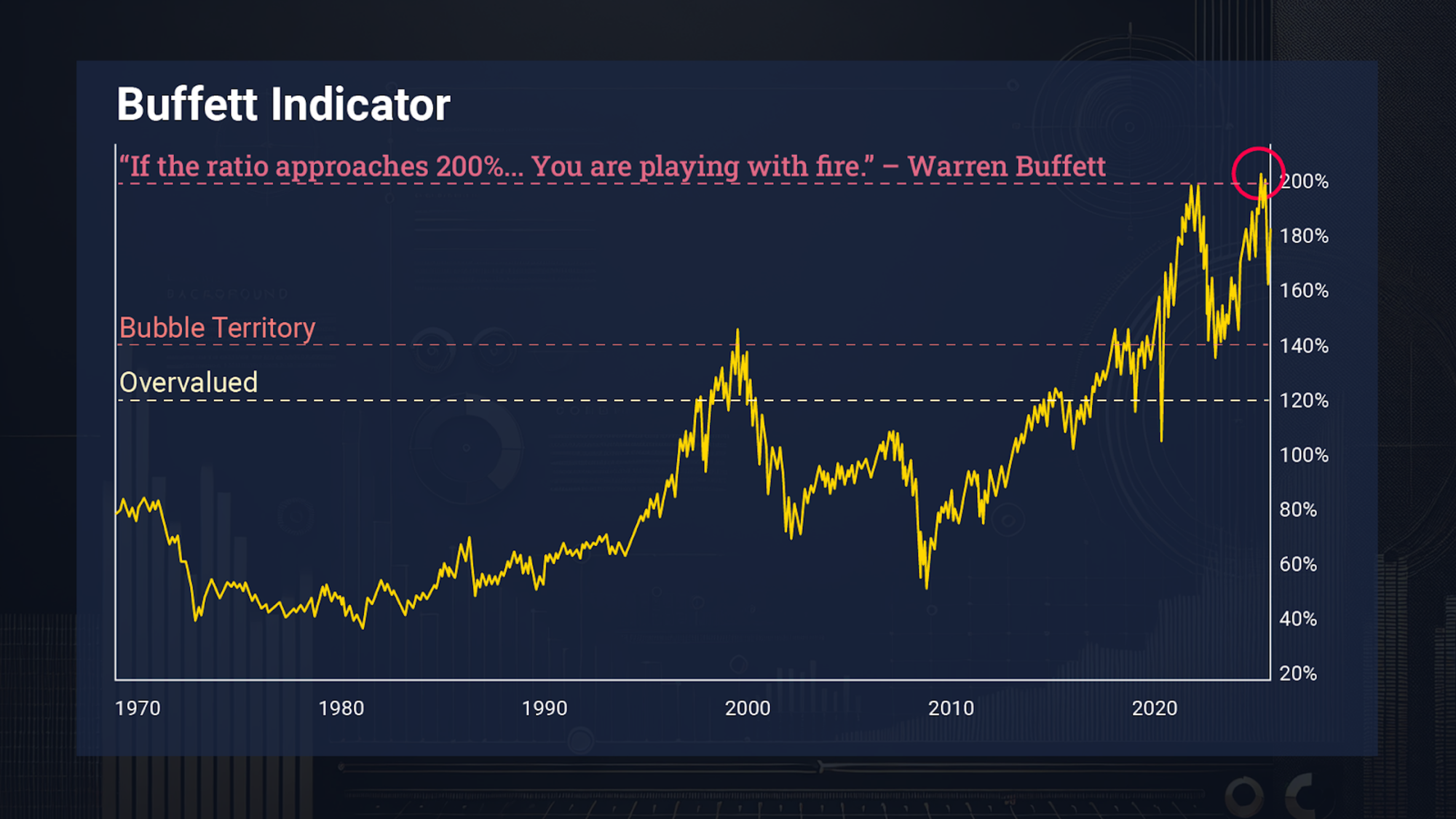
Every time the “Buffett Indicator” reaches a peak…
Gold goes on a tear for a decade or more. Every. Single. Time.
That’s why I believe Buffett is preparing to buy the one gold miner large enough to protect his cash. And here’s the kicker…
What’s more, Trump recently tapped the CEO of this mining powerhouse to help lead America’s mining revival!
Add it all up and here’s what you get:
- The US Treasury Secretary is positioned for a major move in gold… and move that’s sure to come when he authorizes all the money required to finance more deficit spending.
- The world’s greatest investor needs a major gold position to protect his $330 billion cash pile… and there’s only one company big enough to do it.
- Trump has entrusted the CEO of the #1 major gold miner to lead a Renaissance in US mining.
Final confirmation of my prediction could come by May 15th — when Buffett’s 13F filing hits the tape.
You want to be in position before that happens.
You still have time to “front run” the world’s greatest investor by taking a stake in the one mining company big enough to handle his $330 billion cash hoard.
That’s why I’ve prepared a private gold briefing with:
- The name and ticker of the company Buffett is likely targeting
- Four tiny gold miners with “anomaly” upside potential up to 100X
- A special bonus pick about to ramp up to full production… selling at an 83% discount to fair value… and led by a CEO whose last project turned $18 million into $1.2 billion for shareholders…
Go here to get the name and ticker of Buffett’s next big move into gold.
Rising Government Debt and Currency Concerns
One of the most frequently cited drivers behind renewed interest in gold is the rapid growth of sovereign debt.
The United States alone now carries more than $37 trillion in federal debt, a level that continues to rise as governments finance spending through borrowing. Large deficits can place pressure on currencies over time, especially if investors begin to question fiscal sustainability.
In this environment, gold often gains attention as an asset that exists outside the traditional financial system.
Unlike government bonds or fiat currencies, gold cannot be printed or expanded through monetary policy. Its supply grows slowly through mining, which is one reason it is often viewed as a long-term hedge against currency debasement.
Central Banks Are Buying Gold Again
One of the most significant shifts in recent years has been the behavior of central banks.
For decades, many central banks were net sellers of gold. That trend has reversed dramatically.
Central banks have now been net buyers of gold for more than a decade, and recent purchases have reached historically high levels. According to research from the World Gold Council, central banks purchased over 1,000 tonnes of gold annually in several recent years, with demand remaining strong into 2026.
This sustained buying has contributed to a structural change in the global reserve system. In fact, the total value of gold held by foreign central banks has recently surpassed their holdings of U.S. Treasury securities for the first time since the mid-1990s, highlighting a gradual diversification away from dollar-denominated assets.
Many emerging market economies—including China, Turkey, and several Eastern European countries—have been among the largest buyers.
Gold and Geopolitical Risk
Another reason gold periodically attracts investor attention is geopolitical instability.
Recent global events have once again demonstrated gold’s reputation as a “safe-haven” asset. When geopolitical tensions rise, investors often seek assets that are perceived as stable stores of value.
Recent market developments illustrate how quickly gold demand can react to global events. Escalating tensions in the Middle East recently pushed gold prices higher as investors sought defensive assets amid fears of energy disruptions and inflation.
At the same time, analysts have noted that investors are increasingly turning to gold rather than long-term government bonds when geopolitical risk rises, reflecting concerns that inflation and rising yields may weaken the traditional role of bonds as safe-haven assets.
Even so, gold prices can remain volatile. Stronger currencies or rising interest rates sometimes temporarily reduce demand because gold does not generate yield.
A Structural Shift in Global Reserves
Beyond short-term price movements, a deeper structural change may be taking place in global reserve strategies.
Many governments and central banks are gradually diversifying their reserves, reducing reliance on any single asset class or currency.
Several factors appear to be driving this shift:
• geopolitical fragmentation and sanctions risk
• growing sovereign debt levels in major economies
• long-term inflation concerns
• the desire for assets that are not tied to any one country’s monetary policy
As a result, gold has increasingly been viewed as a neutral reserve asset that can complement traditional holdings such as U.S. Treasuries, euros, or foreign currencies.
Gold’s Role for Investors
For individual investors and institutions alike, gold plays several potential roles within a portfolio.
Historically, investors have used gold for:
- diversification alongside equities and bonds
- protection during financial crises
- a hedge against inflation and currency weakness
- exposure to commodity markets
The metal’s performance can differ significantly from stocks or bonds, which is why it is often considered a diversification tool rather than a growth investment.
Gold’s renewed prominence in financial markets reflects a combination of macroeconomic forces.
Rising government debt, geopolitical uncertainty, structural changes in central-bank reserve strategies, and shifting investor preferences have all contributed to the metal’s growing relevance in global finance.
While gold prices can fluctuate in the short term, its long history as a monetary asset ensures that it remains closely watched by policymakers, investors, and market analysts alike.
As the global financial system continues to evolve, the role of gold—both as a reserve asset and an investment—will likely remain an important topic in discussions about the future of money.
Special Bonus by Lear Capital